
Scrap Metal Recycling: Why the Metal Alone Doesn’t Set the Price
Imagine two loads of copper arriving at the scrap yard the same morning.
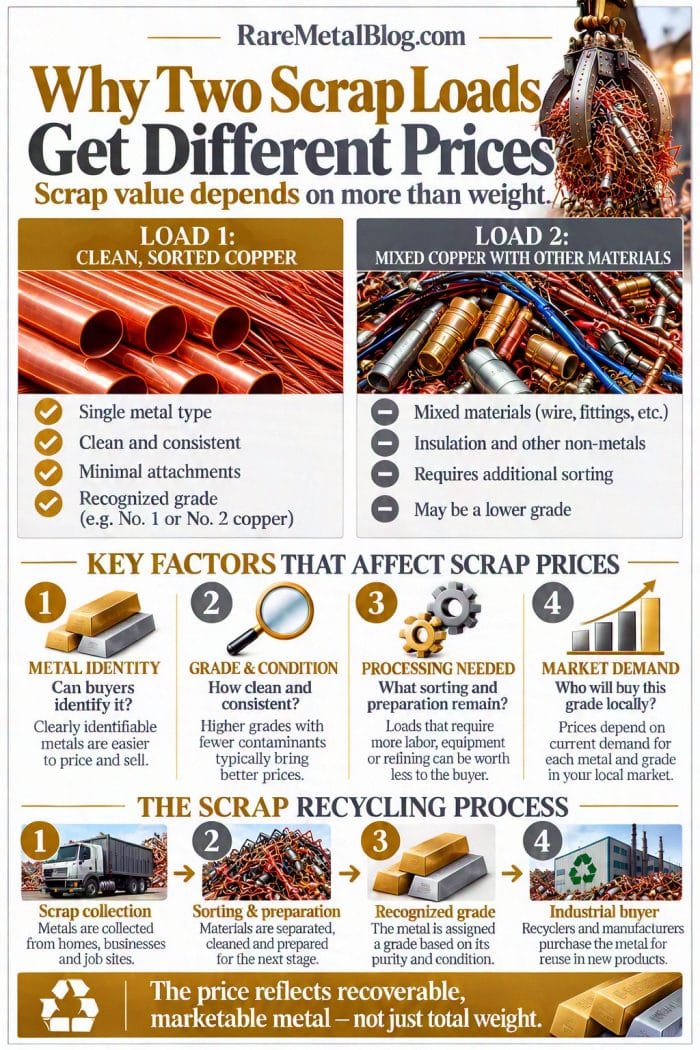
The first is from a workshop. It’s clean offcuts, all of the same material, collected in a separate container. The second is from a building refurbishment. It certainly has copper in it, but also insulation, fittings, old fasteners and bits of other metal.
You’d think the price difference would be all about the weight. The heavier load has more stuff in it, after all.
But the purchaser has another question: What percentage of that weight can be sold as a recognizable grade of copper?
This is where scrap metal recycling becomes more than just gathering and melting down old metal. The material must be reintroduced into manufacturing, and the intervening steps can significantly alter its value.
The Scrap Yard Is Selling Something More Specific Than Metal
A recycling yard might intake steel beams from a demolished building, aluminum from a manufacturing plant, and a box of mixed metal fittings from a repair shop.
All three loads have recyclable material. They are not the same thing.
Eventually the steel can be used in steelmaking. The aluminum could be used as a raw material for another aluminum product. The copper from the old equipment can be used in new industrial processes.
Manufacturing offcuts are another important source of scrap. Work such as metal fabrication can produce identifiable pieces of material before they ever become part of a finished product.
Before any of this material can be sold onward, somebody has to establish what it actually is.
Iron and steel scrap is generally classified as ferrous metals. Nonferrous categories include copper, aluminum and many other metals. This is a useful first distinction but doesn’t give a buyer enough information to make a proper purchasing decision.
Even within a family of metals, there can be large differences in composition and condition.
A clean aluminum sheet is not necessarily the same commercial product as a mixed bag of painted aluminum parts, castings and fasteners. And so it is with steel. A known manufacturing offcut is a different proposition to a pile of heavily contaminated demolition material.
That’s why we have scrap grades.
Material specifications are written in terms buyers and sellers understand. They may be concerned with composition, dimensions, cleanliness or presence of extraneous matter.
The point is not to give a complicated name to every discarded object. It’s to make the material predictable enough for somebody else to use.
A recycling yard therefore does more than dispose of unwanted metal. It is helping to convert irregular supplies of discarded material into industrial raw materials that can be bought with some confidence.
A Scrap Price Is Not Just a Metal Price
When you look up scrap metal recycling prices you may see a number quoted per pound or per ton.
That number can be helpful. It also can be confusing if you don’t know what it’s referring to.
Local recycling yards pay different prices for a small mixed load of steel scrap than industrial buyers may pay for a particular grade of steel scrap. There are various transactions taking place.
For example, the USGS Mineral Commodity Summaries report prices for defined industrial scrap categories. Those figures should not be mistaken for universal scrap-yard buying prices.
The yard may have to process the material, store it, prepare it for shipment and find a buyer. Some loads are simple. Others are more work and more uncertain.
Copper is just one example.
You will likely find it easier to grade and market clean, identifiable copper scrap than material with a lot of insulation or other fittings attached. Both loads could have some useful copper but the second does leave one wondering just how much recoverable metal is actually there.
Aluminum has complications of its own. Various alloys are used for various purposes and mixing them indiscriminately can make the resulting scrap less suitable for some buyers.
Steel is often traded in large lots, but that does not imply that every piece of steel is equally acceptable. Size, condition and unwanted attachments can be important.
Then there’s the market itself.
Demand from manufacturers and metal processors can shift. Transport costs are location-sensitive. A yard that buys several tons of a known grade may be able to offer different terms than one that gets a small, inconsistent assortment.
This is why a published commodity price does not guarantee a scrap-yard payment at that price.
And it explains why “What’s the price of scrap metal today?” is a half-question.
The other half of the question is “what sort of scrap metal in what condition and to whom delivered?”
The Work That Happens Before Scrap Becomes Feedstock
It is tempting to think of recycling as a simple sequence of steps: collect metal, melt metal, make something new.
Some material is fairly straightforward. Other scrap requires a lot of work before it can be used.
Picture an old piece of machinery. It might be made of steel panels, copper wiring, aluminum parts, coatings and plastic.
The equipment is no longer necessary, but the metals have not lost their utility. But they are attached to things that might not be in the same stream of recycling.
One part of the job is separating those materials.
Scrap processors may sort metals by type, remove unsuitable attachments and prepare material into forms that downstream buyers can handle. That can involve industrial sorting, cutting, shredding or other processing, depending on the operation.
The importance of material condition is reflected in industry specifications for ferrous scrap, which address cleanliness, unwanted material and other requirements.
The point is not always to obtain a perfectly pure metal. It is to provide material that meets the requirements of the next user.
That’s an important difference.
A steel maker and an aluminum processor are not necessarily seeking the same things. Even the same general metal may have two buyers with different specifications.
Some scrap is hard to economically recover, even if it has valuable material in it.
The same difficulty can arise when recycling certain critical minerals. Having useful material in a discarded product does not necessarily make its recovery commercially practical.
A thin coating, a bonded component, or a blend of alloys that look similar can cause more problems than it appears to.
The metal might still be around.
Another thing is putting it into a form that somebody wants to buy.
RMB’s Take: The Price Is for Recoverable Metal, Not Just Weight
Here at RareMetalBlog, we believe that one of the most useful ways of analyzing scrap value is to look beyond the headline metal price.
Consider a buyer who receives two equal-weight loads.
One has a definite grade, with little extraneous material. The second is a mixture, which needs further sorting and is not of completely certain composition.
The second load may contain valuable metal. That doesn’t mean the buyer can treat all its weight as saleable material of the highest grade.
We begin our assessment with four questions.
The RMB Scrap Value Assessment
| What we examine | Why it matters |
|---|---|
| Metal identity | Can the material be confidently identified, or is its composition uncertain? |
| Grade and condition | Does it meet a recognized scrap specification, and how much unwanted material is present? |
| Remaining processing | How much separation, preparation or other work is needed before the material can be sold on? |
| Market demand | Is there a buyer for that grade, in that quantity, at that location? |
These questions are related. They are not identical.
A load could be very clean but still get a bad offer if the buyer doesn’t have much demand for it. Another may need processing but be commercially viable because its recoverable metal is valuable.
There is also a difference between knowing what metal is present and knowing what a buyer will pay for it. A recognizable grade can make a load easier to trade, but it doesn’t eliminate transport costs, local market conditions or the work that remains.
So the heaviest load is not necessarily the best load, and the highest quoted commodity price is not necessarily the price a seller is paid.
This is RMB’s editorial assessment based on established recycling and scrap-trading principles. It isn’t based on laboratory tests we conducted or a survey of actual scrap-yard offers.
Frequently Asked Questions About Scrap Metal Recycling
What Scrap Metals Are Commonly Recycled?
Examples of this are steel, aluminum and copper. Brass, lead and other industrial alloys are also recycled but the collection and processing needs can be different.
What Causes Scrap Metal Prices to Change?
Prices will vary with industrial demand, the market for specific metals and local buying conditions. The grade, condition, and quantity of the scrap also influence what a buyer might pay.
Is Clean Scrap Always More Valuable Than Mixed Scrap?
Not automatically. Well-identified scrap can be easier to market, but the actual price depends on the grade of the scrap, the metal involved and the requirements of the buyer. A clean load does not guarantee a premium.

